
X60Q and X60QS are not two strength grades. Both sit on the same 415–565 MPa yield window, both carry a 520 MPa minimum tensile, and a line designed around one will not need a different wall thickness with the other. What changes is the steel behind the number: sulfur falls from 0.015% to 0.003%, phosphorus from 0.025% to 0.020%, carbon from 0.18% to 0.16%, and the pipe has to clear a 250 HV10 hardness cap along with HIC and SSC testing that an X60Q order never sees. Q tells the mill how to heat treat the pipe. S tells it what the pipe has to survive.
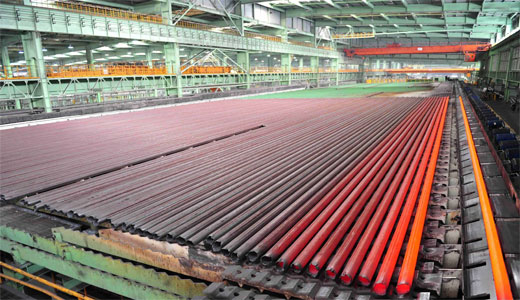
X60QS is supplied as seamless pipe from 60.3 mm to 610 mm outside diameter (2 to 24 in) with wall from 5.5 mm to 40 mm, quenched and tempered, in lengths of 6 to 12 m. Welded sour pipe is normally ordered as X60MS in LSAW or HFW, where the design and the seam hardness allow it. Heats are desulfurized and calcium treated, hardness is mapped across body, seam and heat-affected zone, and each order ships with HIC and SSC reports alongside an EN 10204 3.1 or 3.2 certificate. Third-party inspection by SGS, BV or TÜV can be arranged at the mill.
API 5L builds a PSL2 grade from three parts: the strength designation, a delivery condition letter, and, when it applies, a service letter. X60 is the strength. Q is the delivery condition. S is the service qualifier, and it points the whole order at Annex H.
| Suffix | Meaning | Where it comes from | Typical use |
|---|---|---|---|
| R | As-rolled | Table 3, delivery condition | Low-cost PSL2, thin wall, moderate pressure |
| N | Normalized, or normalized and tempered | Table 3, delivery condition | Thick wall where toughness matters more than strength |
| Q | Quenched and tempered | Table 3, delivery condition | Thick wall, tight strength window, uniform hardness |
| M | Thermomechanically rolled (TMCP) | Table 3, delivery condition | High strength with lower carbon, welded pipe |
| S | Sour service, Annex H applies | Annex H, additional requirement | Wet H2S, HIC and SSC risk |
So X60NS, X60QS and X60MS are all valid designations, and all three are sour grades. The letter in front of the S is the heat treatment the mill used to get there. It is not a strength step. A normalized sour pipe and a quenched and tempered sour pipe both still have to make 415 MPa minimum yield.
One practical consequence: S does not appear in the main mechanical table. Annex H carries its own tables, H.1 for chemistry and H.2 for tensile results. The values are mostly the same as Table 7. The table reference on the certificate should be H.2, not 7.
This is where the two grades actually part. Left column is X60Q from Table 6 of the general PSL2 requirements. Right column is X60QS from Annex H Table H.1, seamless column.
| Element, % max | X60Q (Table 6) | X60QS (Table H.1, SMLS) | Note |
|---|---|---|---|
| C | 0.18 | 0.16 | Lower carbon protects hardness in the HAZ |
| Si | 0.45 | 0.45 | Unchanged |
| Mn | 1.70 | 1.65 | Slightly lower to hold the carbon equivalent |
| P | 0.025 | 0.020 | Segregation control |
| S | 0.015 | 0.003 | Five times tighter; the defining number |
| V | As agreed, Nb+V+Ti ≤ 0.15 | 0.08 | Separate caps in Annex H |
| Nb | As agreed, Nb+V+Ti ≤ 0.15 | 0.05 | Separate caps in Annex H |
| Ti | As agreed, Nb+V+Ti ≤ 0.15 | 0.04 | Separate caps in Annex H |
| CEIIW | 0.43 | 0.41 | Applies when C > 0.12% |
| CEPcm | 0.25 | 0.22, +0.03 allowed on SMLS | Read the footnote before quoting this |
| Cu | 0.50 | 0.35 | Residual limit, not an alloy addition |
| Ni | 0.50 | 0.30 | Residual limit |
| Cr | 0.50 | 0.30 | Hardenability control in the weld zone |
| Mo | 0.50 | 0.15 | Hardenability control in the weld zone |
| B | 0.001 residual | 0.0005 | Boron raises HAZ hardness at trace levels |
| Ca | Not specified | 0.006 max, Ca/S ≥ 1.5 where Ca is added | Inclusion shape control |
| Al, N | Not specified | Al 0.060 max, N 0.012 max, Al/N ≥ 2:1 | Fully killed, fine grain |
Values from API 5L Table 6 and Annex H Table H.1. Annex H footnote e allows sulfur up to 0.008% on seamless pipe by agreement, and footnote h allows the listed CEPcm to be raised by 0.03 on seamless pipe. Confirm against the edition of API 5L named in the purchase order.
Hydrogen induced cracking does not start at a defect. It starts at an inclusion. Hydrogen atoms generated at the steel surface by the H2S reaction diffuse into the wall, meet at the flat, elongated manganese sulfide inclusions and the centerline segregation that rolling leaves behind, and recombine into H2 molecules. The gas cannot diffuse out, so pressure builds in the void until the steel tears. Repeat that on parallel planes and the cracks link up stepwise through the wall.
Every part of that chain is decided at the steelworks, not at the coating plant. Type II MnS is elongated in the rolling direction, which is why HIC cracks run parallel to the surface and why a pipe can look perfect from outside while the mid-wall is delaminated. Two things break the chain:
Sulfide stress cracking is a different failure from HIC. It needs three things at once: hydrogen, tensile stress, and a locally hard microstructure. Remove the hardness and the mechanism loses its starting point, which is why Annex H caps hardness at 250 HV10, about 22 HRC, and asks for it to be measured across the pipe body and, on welded pipe, the seam and heat-affected zone.
This is where the Q in X60QS earns its place. A quenched and tempered pipe at 0.16% carbon and 1.65% manganese produces tempered martensite or bainite at roughly 200 to 230 HV10, and it does so uniformly through the wall. An as-rolled or normalized heavy wall can carry banded pearlite and segregation rows that read 260 to 280 HV10 in a traverse even when the tensile test passes comfortably. The average is fine; the band is not.
That is the reason thick-wall sour pipe gravitates to Q&T rather than TMCP, and the reason is hardness uniformity, not strength. It is also why the cap is a full-section obligation: a hardness survey that reports one value per pipe proves nothing. The check is a traverse, on body, seam and HAZ, at the frequency Table H.3 sets for the heat.
And it does not stop at the mill gate. The girth welds have to meet the same cap. A line can be built entirely from compliant X60QS and still fail its pre-commissioning hardness survey at the tie-ins, because a welding procedure qualified on tensile and toughness alone will produce a harder cap and root than the pipe it joins.
The chemistry change is the visible half. The other half is a test package that runs on a calendar, not a shift rota.
| Test | X60Q | X60QS | Method and duration |
|---|---|---|---|
| Tensile, body and weld | Required | Required | API 5L, per heat |
| Charpy, body / seam / HAZ | Required at PSL2 | Required | API 5L size and grade chart |
| Hardness traverse | Not required | Required, ≤ 250 HV10 | Body, seam, HAZ; frequency per Table H.3 |
| HIC | Not required | Required | NACE TM0284, Solution A, 96 h |
| SSC | Not required | Required | NACE TM0177 Method A, 720 h at 80% SMYS |
| UT for laminar imperfections | Not required | Per Annex H H.2 b) and l) | Strip or plate, plus 100 mm at pipe ends when t ≥ 5 mm |
| MPI at pipe ends | Not required | Per Annex H H.2 m) | End face and bevel |
| Photomicrographs of HIC cracks | Not required | Per Annex H H.2 j) | Reportable cracks, if any |
The SSC test is the one that sets the delivery date. Method A runs 720 hours, which is 30 days of immersion before the specimen is even sectioned, and it only starts once the test pieces are machined and the fixture is loaded. Add the HIC run, the metallography and the lab queue and a first heat is looking at five to six weeks of testing on its own. A buyer who needs pipe on site in eight weeks and places a sour order in week six has not bought pipe. He has bought an argument.
Acceptance criteria are worth pinning down in the order as well. Annex H specifies the test methods and leaves room for alternative criteria by agreement, so the numbers that decide pass or fail are usually the project's: CLR ≤ 15%, CTR ≤ 5% and CSR ≤ 2% for HIC, and no cracking at 80% SMYS after 720 hours for SSC. Write them into the purchase order rather than assuming the mill's default matches the client's specification.
Annex H Table H.1 carries both seamless and welded columns, so a welded X60QS is not forbidden. In practice welded sour pipe is ordered as X60MS, and its limits explain why.
| Element, % max | X60QS, SMLS | X60MS, welded |
|---|---|---|
| C | 0.16 | 0.10 |
| Mn | 1.65 | 1.45 |
| P | 0.020 | 0.020 |
| S | 0.003 | 0.002 |
| CEIIW | 0.41 | Not specified |
| CEPcm | 0.22, +0.03 on SMLS | 0.21 |
The welded sour grade is harder to make than the seamless one: carbon at 0.10% instead of 0.16%, sulfur at 0.002% instead of 0.003%, and a carbon equivalent of 0.21 with no seamless allowance. The reason is the seam. A whole tube can be austenitized, quenched and tempered with its hardness controlled by the tempering temperature. A weld seam and its heat-affected zone are quenched by the surrounding plate, and the only levers left are chemistry and heat input. So the chemistry is made easy to weld and hard to harden.
If a quotation offers welded X60QS, the question to ask is how the seam was heat treated and where the hardness traverse was taken. If the answer is a normalized seam on a quenched body, the pipe may still comply, but the two halves were treated differently and the traverse is the only evidence that matters.
Nothing in an X60QS order is expensive because of strength. The cost sits in three places, and buyers tend to budget for the wrong one.
Which leads to the only useful rule on price: if a quote for X60QS lands close to the X60M number, the question is not how they did it, it is which tests were dropped. Sulfur that is not held, hardness that is not mapped and SSC that is not run all look identical on a one-page quotation.
No. Both are 415–565 MPa yield and 520–760 MPa tensile. The S adds a service requirement and tighter chemistry; it does not add strength, and it will not reduce wall thickness in a design calculation.
Not by itself. Annex H is the API route to a sour-service pipe; MR0175/ISO 15156 is a selection standard applied to the line. They overlap heavily, and most projects require both, but the evidence is the hardness traverse plus the HIC and SSC reports, not the grade letter on the certificate.
You can, and it will usually fail. At 0.015% sulfur the inclusion population is five times larger than a sour heat, and CLR values well above 15% are normal. Testing a heat that was not made for sour service is money spent to confirm a decision that was already made at the steelworks.
QS is seamless, quenched and tempered. MS is welded, thermomechanically rolled, with a tighter chemistry: carbon 0.10% instead of 0.16%, sulfur 0.002% instead of 0.003%, CEPcm 0.21 with no seamless allowance. Both are Annex H grades and both must clear 250 HV10.
On the pipe body, and on the seam and heat-affected zone for welded pipe, across the full wall rather than at a single point. The same cap applies at the girth welds, so the welding procedure has to be qualified against it, not just the pipe.
Plan on five to six weeks of testing before shipment can be considered: 96 hours for HIC, 720 hours for SSC, plus machining, metallography and laboratory queue. Add heat scheduling and the Q&T run on top of that. Sour orders are placed against a schedule, not against a stock list.
Annex H footnote e allows up to 0.008% on seamless pipe by agreement. It is a risk decision, not a specification detail, and it should be visible in the purchase order rather than appearing in a mill's counter-offer. If sulfur moves, the HIC result moves with it.