

Casing is the large-diameter pipe run and cemented in stages from the surface downward. It keeps the wellbore open, seals off freshwater zones and unstable or high-pressure formations, and provides a pressure-containing barrier for the life of the well. A typical petroleum or natural gas well is built from several nested casing strings: a conductor at the top, surface casing for groundwater protection and wellhead support, intermediate casing to isolate problem intervals, and production casing that reaches the reservoir.
Tubing is the smaller string installed inside the production casing. Unlike casing, tubing is not cemented; it is suspended from the wellhead and is the actual flow path for petroleum and natural gas. Because it is exposed to produced fluids, corrosion and repeated workovers, tubing is designed to be retrieved and replaced without pulling the casing. The distinction matters for sourcing: casing is a capital, one-time installation, while tubing is a consumable that drilling and completion engineers size for flow rate, deposition and corrosion allowance.
Casing and tubing for petroleum and natural gas service are most commonly ordered to API Spec 5CT (equivalent to ISO 11960). The standard defines grades by minimum yield strength and groups them by chemistry and heat-treatment route. The grade selected is driven by the well's mechanical design — burst, collapse and axial tension — rather than by a single default choice.
| Grade | Min. yield (psi) | Max. yield (psi) | Typical use in petroleum & natural gas wells |
|---|---|---|---|
| H40 | 40,000 | 80,000 | Conductor and low-load surface strings |
| J55 / K55 | 55,000 | 80,000 | Surface and shallow intermediate strings (K55 carries higher min. tensile) |
| N80 (Type 1 / Q) | 80,000 | 110,000 | Intermediate and production strings |
| L80 (Type 1 / 9Cr / 13Cr) | 80,000 | 95,000 | Production; Type 1 qualified for sour service |
| C90 / T95 | 90,000 / 95,000 | 105,000 / 110,000 | Sour-service intermediate and production |
| P110 | 110,000 | 140,000 | Deep, high-pressure production strings |
| Q125 | 125,000 | 150,000 | Deep, high-load HPHT wells |
For wells with H₂S, specify sour-service grades (L80 Type 1, C90, T95) and verify material and hardness controls per NACE MR0175 / ISO 15156. Casing and tubing are furnished at Product Specification Levels PSL-1, PSL-2 or PSL-3, with PSL-2 and PSL-3 adding stricter chemical, mechanical and non-destructive testing requirements.
The threaded connection determines how individual joints make up a string and how much axial and pressure load the joint can carry. Casing and tubing use different connection families, all threaded and inspected to API Spec 5B.
| Product | Connection | Form | Typical application |
|---|---|---|---|
| Casing | STC | Short round thread | Shallow, low-load strings |
| LTC | Long round thread | Medium-depth wells (~95–98% joint efficiency) | |
| BTC | Buttress | Deeper / high-tension strings (~100% pipe-body joint strength) | |
| Tubing | EUE | External upset | Most production tubing; stronger joint, reusable |
| NUE | Non-upset | Lower-cost, lighter-service tubing |
Proprietary premium connections (gas-tight metal-to-metal seals) are specified for HPHT, high-deviation or sour-gas wells where API round/buttress threads do not meet the sealing or tension requirement. They are evaluated case by case against the completion design.
API Spec 5CT covers a wide range of outside diameters so that the same material system serves every string in the well:
Casing and tubing are selected against the specific petroleum or natural gas environment the string will see:
Casing and tubing are produced as seamless (hot-rolled from solid billet, the dominant form where pressure integrity is critical) or as ERW (strip formed and longitudinally welded, with the weld and heat-affected zone heat-treated so seam properties match the pipe body). Both are delivered in the heat-treatment condition required by the grade.
Quality control follows the ordered PSL level and typically includes:
GNEE supplies API Spec 5CT / ISO 11960 casing and tubing across the grade and connection range above, with mill-direct sourcing, EN 10204 3.1 documentation and third-party inspection options. Indicative FOB China pricing for standard OCTG generally falls in the range of US$1,200 to 3,200 per ton depending on grade, size, PSL level and quantity, and moves with steel market conditions. Standard items typically ship in 20 to 45 days; exact quotations follow the specification and order volume, with CIF/CFR terms to the destination port available on request.
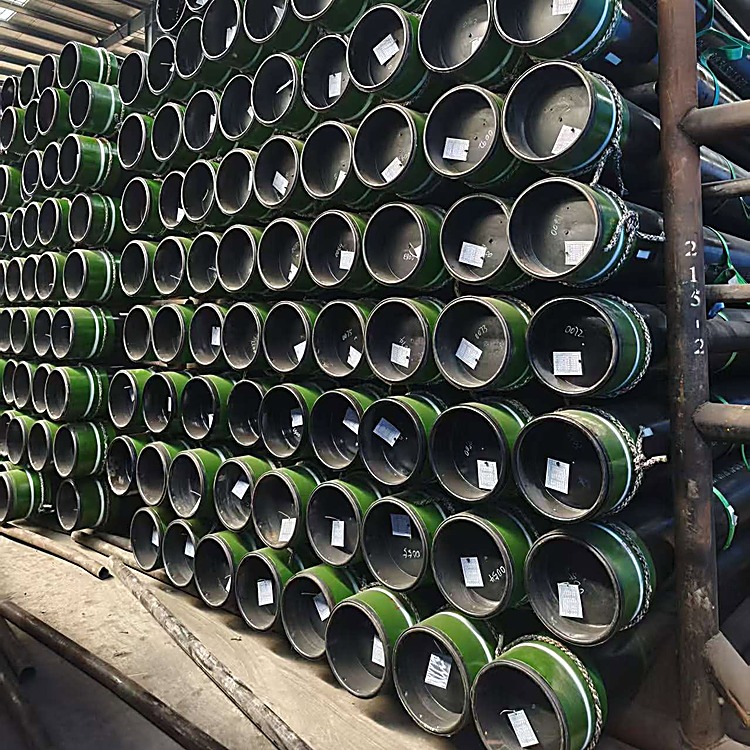
Casing is the permanent string cemented or suspended in the wellbore to support the hole, isolate formations and protect groundwater; it runs from the surface down to or near the target zone. Tubing is the smaller-diameter string installed inside the production casing through which oil and gas flow to the surface, and it is designed to be retrieved and replaced during the well's life.
Common grades run from H40 and J55/K55 at the low end, through N80 and L80 in the mid range, to C90, T95, P110 and Q125 at the high-strength end. L80 Type 1, C90 and T95 are selected for sour (H2S) service in line with NACE MR0175 / ISO 15156; the grade is chosen from the well's burst, collapse and tension design.
Casing is supplied with STC (short round thread), LTC (long round thread) or BTC (buttress) connections machined per API Spec 5B; BTC gives joint strength approaching 100% of the pipe body for deeper, higher-tension strings. Tubing typically uses EUE (external upset) or NUE (non-upset) threads, also per API Spec 5B, with proprietary premium connections available for gas-tight or HPHT service.
Casing outside diameters generally span 4-1/2 in (114.3 mm) up to 36 in (914 mm) for conductor and surface strings. Tubing outside diameters run from 1.05 in (26.7 mm) to 4.5 in (114.3 mm), with 2-3/8 in, 2-7/8 in and 3-1/2 in the most common production sizes. Both are supplied in API length ranges R1, R2 and R3.
Each order is supported by an EN 10204 Type 3.1 mill test certificate covering chemistry and mechanical properties, hydrostatic pressure testing per API Spec 5CT, tensile and flattening tests, non-destructive testing (UT, MPI or eddy current) per the specified PSL-1 / PSL-2 / PSL-3 level, drift testing on every joint and thread gauging per API Spec 5B; third-party inspection by SGS, BV or TÜV can be arranged.
Indicative FOB China pricing for API Spec 5CT OCTG generally falls in the range of US$1,200 to 3,200 per ton depending on grade, size, PSL level and quantity, moving with steel market conditions. Standard items typically ship in 20 to 45 days; firm quotations follow the exact specification and volume.
Send your casing or tubing program — outside diameter, weight per unit length, grade, connection, PSL level and quantity — and our technical team will return a firm quotation with lead time and shipping terms. For the full product range and size charts, see the API 5CT casing and tubing product page.


.jpg)